Your Contacts Remember Who. Do You Remember Why?
A name and number can identify a person without preserving the reason they belong in your network.
A contact record can be completely accurate and still tell you almost nothing useful six months later.
You may have the right name, the right number and the right company. Nothing is missing in the technical sense. Yet you open the contact and think: Why do I know this person?
Your contact list remembered the person. It did not necessarily remember the relationship. That distinction matters more as your network grows. The problem is rarely that every contact disappears. The problem is that the meaning behind the contact slowly becomes harder to retrieve.
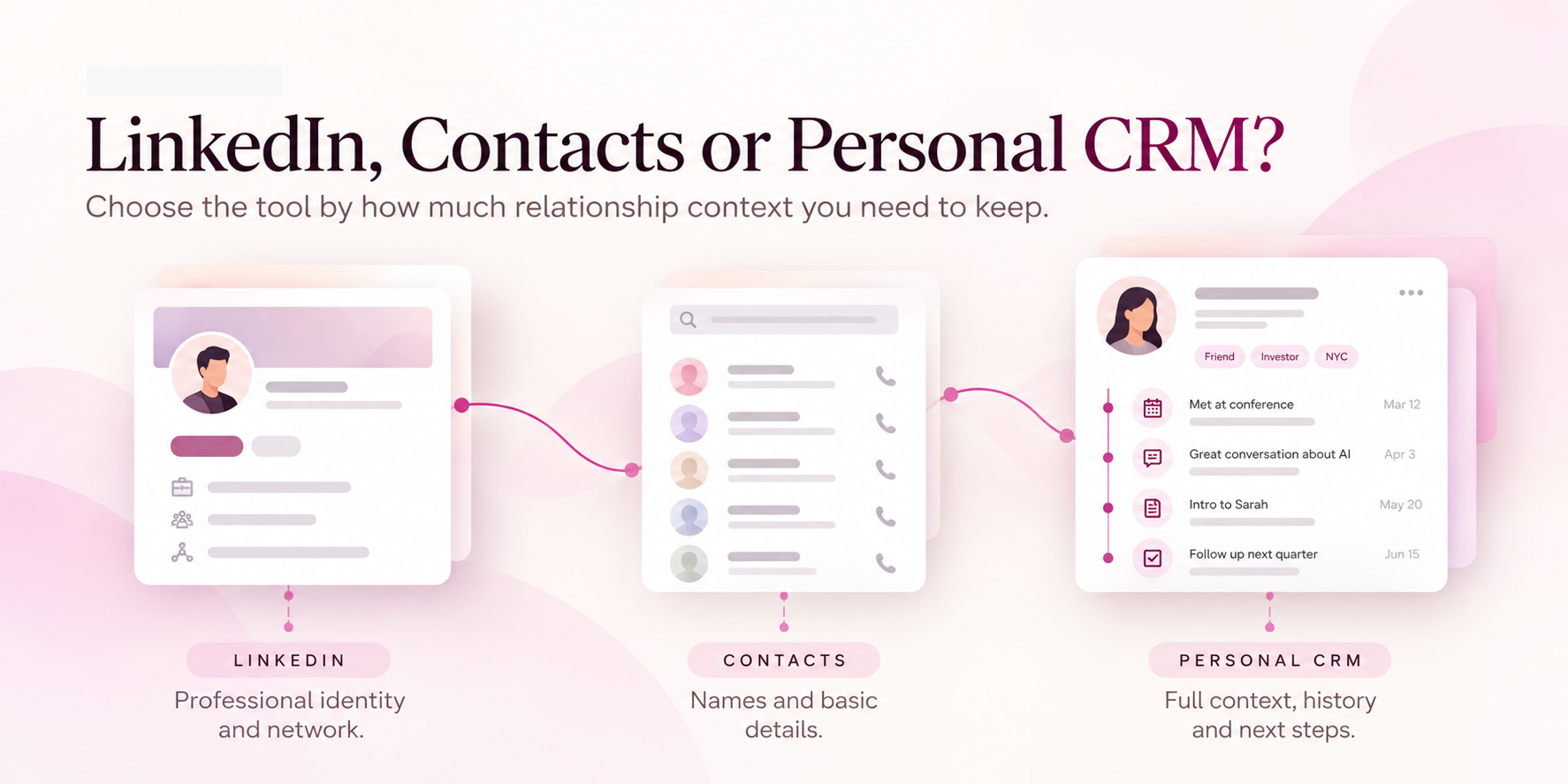
A contact list is a directory.
Directories are excellent at identity. They answer who someone is and how to reach them. Professional relationships carry another layer: how you met, what was relevant, what happened between you and whether the relationship should continue.
Contact record Meera Kapoor Community Lead · Bengaluru · +91…
Relationship record
Meera Kapoor Met at founder dinner · runs Bengaluru community · offered intro to event organiser · reconnect before October meetup
Both identify Meera. Only one restores the reason she is in your network.
We often remember the situation before the name.
Months later, the thought may not be “I need Meera Kapoor.” It may be “Who was the community lead who knew that event organiser?” Or “Who did I meet after the founder dinner?”
Professional recall often begins with a fragment: a place, topic, promise, industry, role or future need. A useful relationship system should help you work backward from that fragment to the person.
This is also why alphabetical contact lists are useful but incomplete. They assume you remember the identity first. Real memory is messier.
The same person can mean different things to different people.
A public profile can tell everyone that Meera runs a founder community. But your relationship with her may be about an event introduction. Someone else may know her as a former colleague. Another person may see her as a potential partner.
Professional identity is shared. Relationship meaning is personal. “Who are they?” and “Why do they matter to me?” are different questions.
The minimum useful relationship record is small.
You do not need to record everything. In many cases, four things are enough:
- Origin. Where or how did the relationship begin?
- Relevance. Why was the person worth remembering?
- Commitment. Did either side promise anything?
- Timing. When might the relationship become useful again?
That might produce a note as short as: “Founder dinner · community lead · event intro · reconnect before October meetup.”
The power is not in the quantity of information. It is in preserving the clues most likely to restore the relationship later.
Different roles lose different kinds of relationship memory.
A founder may forget which investor said to reconnect after traction. A recruiter may forget which candidate was strong but poorly timed. A partnerships lead may remember the company but not the exact collaboration idea. A consultant may remember a useful expert but not what problem they were good at solving.
The pattern is the same: identity survives, but the relationship-specific meaning fades.
More information is not automatically better.
Professional memory should not become surveillance or an excuse to create detailed dossiers on people. Save information that helps you appropriately understand or continue the professional relationship. Leave out sensitive personal information, gossip, speculation and details unrelated to the work.
The goal is not maximum capture. It is minimum useful context.
A bigger network is not automatically a more usable network.
As professional networks grow, the challenge changes. Early on, memory does much of the work. Later, you may recognise dozens of names without being able to reconstruct why they matter.
That is when contact collection starts to create noise. The question becomes less “How many people do I know?” and more “Can I find the relationship I need when a future situation makes it relevant?”
A smaller network you can actually navigate can be more useful than a much larger one that functions like an archive.
Try a simple network audit.
Choose ten professional contacts you added a few months ago. For each one, ask:
- Do I know where we met?
- Do I remember what we discussed?
- Do I know why I saved them?
- Could I find them later if I remembered the conversation but forgot the name?
If identity survives but meaning does not, the gap is not contact storage. It is relationship memory.
A useful network should support questions, not just names.
Over time, you may want to ask:
- Who did I meet in FinTech?
- Who was expanding into India?
- Which recruiter specialised in GTM roles?
- Who offered an introduction to a founder community?
- Who told me to reconnect next quarter?
These are not unusual networking questions. But they are difficult to answer when every relationship has been reduced to a name, company and phone number.
Where Allbuddy fits
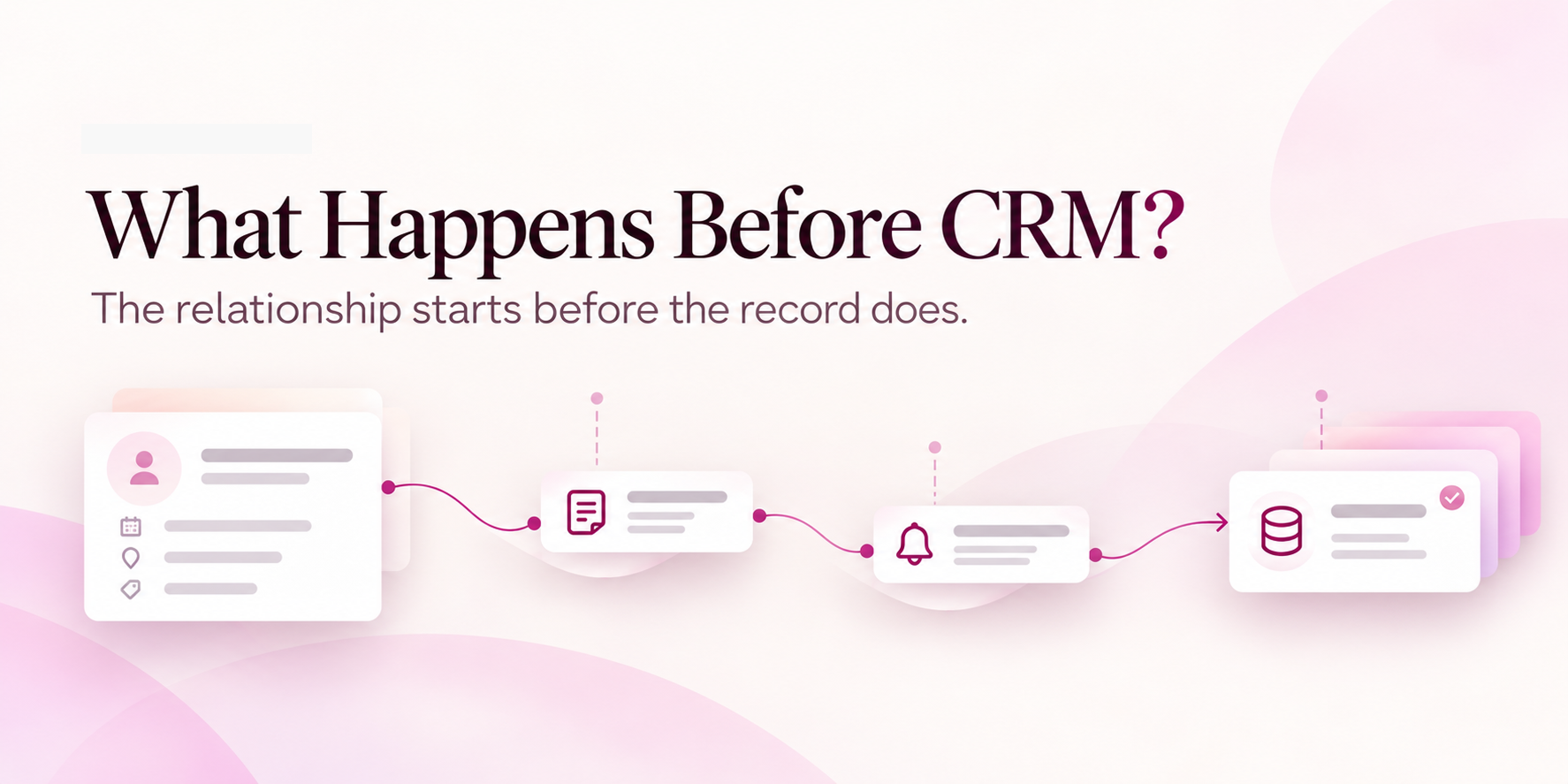
Allbuddy is designed to keep the professional interaction attached to the person. You can capture a contact from a business card or profile QR, add a short text or voice update, organise the relationship by event or context, and return to it later.
The purpose is not to document more. It is to make sure the contact does not survive while the conversation disappears.
The useful question is not “Do I have this person's number?”
It is “Can I understand why this relationship exists?”
A professional network becomes more valuable when you can remember a need—a market, role, introduction, partnership or opportunity—and find the relationship connected to it.
Remember more than the identity.
Keep enough of the relationship to make the person meaningful later.