You meet someone useful. The conversation is relevant. There may be a partnership, introduction, hire or commercial opportunity later, but today there is no deal stage, forecast or formal process.
That early period is easy to mishandle because the relationship is real before the business process is. A phone contact can store the person. LinkedIn can show their professional identity. A CRM becomes valuable once the opportunity is structured. The gap is what happens in between.
For people who network frequently, this gap is not rare. It shows up in conferences, founder communities, industry meetups, coffee chats, investor conversations and warm introductions. The relationship exists, but its future category is still unclear.
CRM is not the problem.
CRM software is designed to bring structure to customer and prospect relationships: ownership, stages, activity, opportunity value, follow-up and reporting. That is exactly why it works well once a relationship has a defined business purpose.
The difficulty is that professional relationships often begin before those fields make sense. The person you met today may later become a customer, partner, investor, candidate, connector, or simply someone worth knowing.
Not every useful professional relationship starts as a lead.
Trying to force every introduction into a pipeline too early creates two problems. First, it adds noise to the system. Second, it encourages people to think about the relationship only through a sales lens, even when the eventual value may come from hiring, partnerships, introductions, market knowledge or timing.
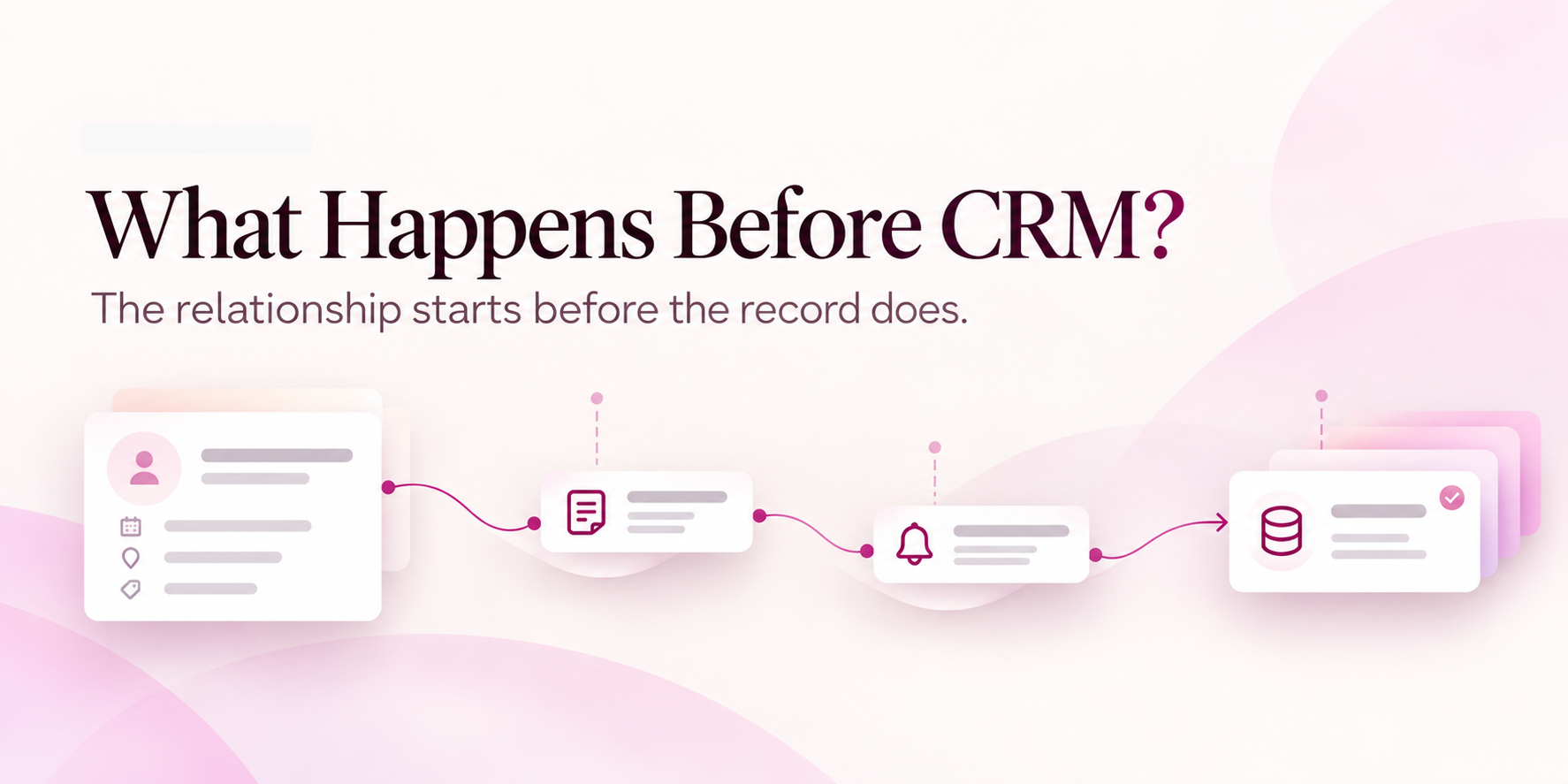
The missing stage is relationship potential.
IntroductionI met this person.
Relationship potentialI know why they may matter.
Defined opportunityThere is now a concrete objective.
Structured processCRM or another system takes over.
The second stage is where most ambiguity lives. There may be relevance without urgency, interest without timing, or a clear reason to reconnect without a formal opportunity.
That ambiguity is exactly why the relationship can disappear. It is important enough to remember, but not structured enough to demand a formal workflow. If nothing preserves the reason behind the interaction, the relationship often degrades into a name, a profile or an email thread.
Different systems answer different questions.
| System | Best at | Question it may not answer on its own |
|---|---|---|
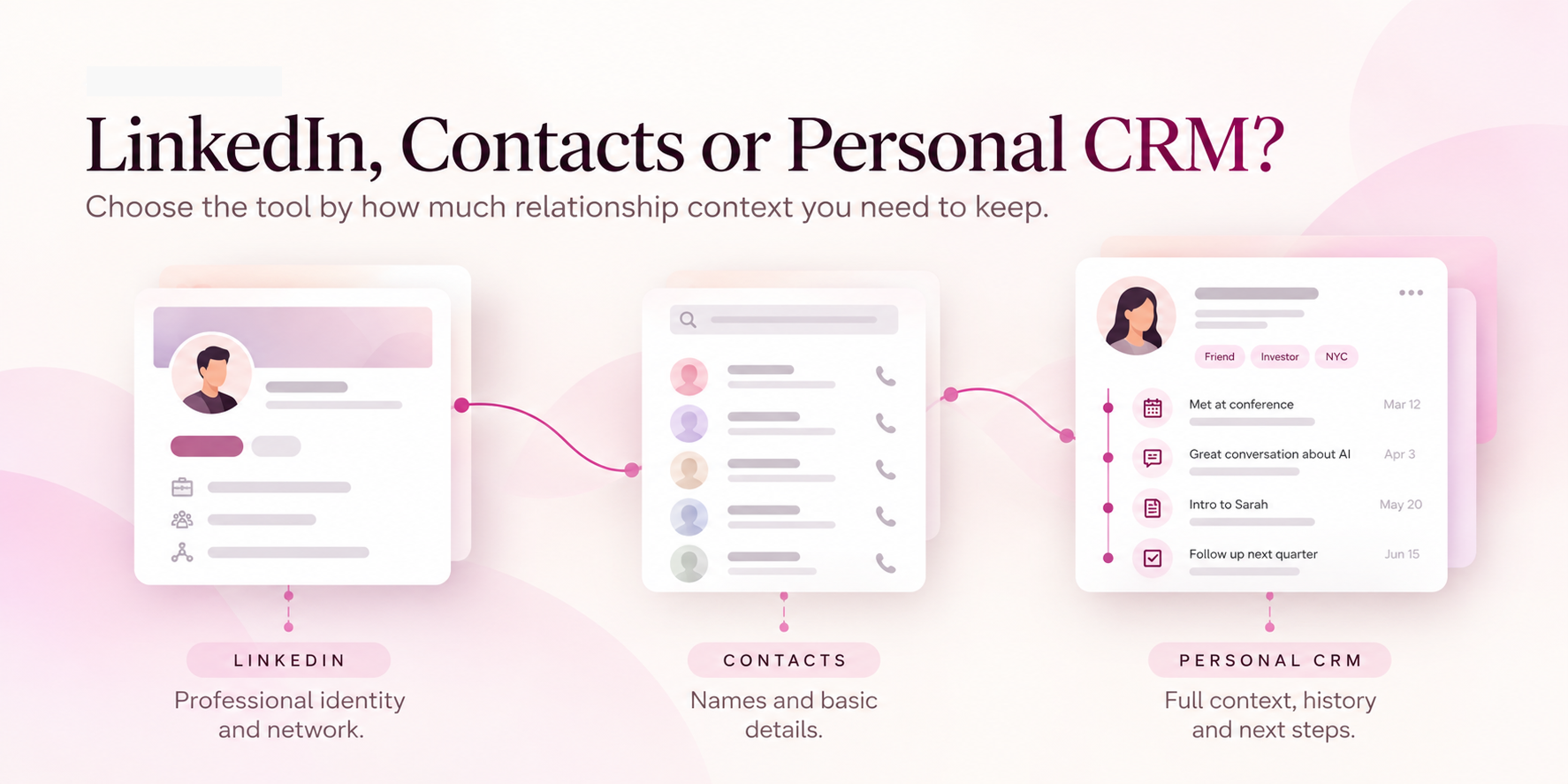
| Contacts | Identity and communication details | Why did I save this person? |
| Professional identity and discovery | What happened when I met them? | |
| Email / messaging | Individual conversations | What is the relationship across interactions? |
| CRM | Structured customer and opportunity workflows | What about relationships that are not yet formal? |
None of these tools is “wrong.” The problem comes from asking one system to answer a question it was never designed to answer.
Why early relationships can still matter later.
A large LinkedIn experiment published in Science studied more than 20 million people over five years and examined how professional ties affected job mobility. The study is about employment outcomes, not sales or partnerships, but it is a useful reminder that opportunity often travels through relationships that are not part of our closest circle.
The implication for networking is not that every loose connection is valuable. It is that future relevance is difficult to predict at the moment of introduction. A weak or dormant relationship may become important when timing, role, company or need changes.
Source: Stanford Digital Economy Lab summary of the LinkedIn weak-ties experiments.
When should a relationship move into CRM?
There is no universal rule, but four signals make the decision easier:
Move it when there is a defined objective, a formal process, a clear owner and a concrete next step or timeline.
For example, a founder you met at an event may not belong in a sales pipeline today. But if that founder asks for a proposal, agrees to a discovery call and gives you a timeline, the relationship has crossed into a more structured stage.
Before that point, the useful job is not aggressive qualification. It is preserving enough information to recognise the relationship when its value becomes clearer.
What should survive before then?
You do not need a full record. A lightweight relationship memory can preserve:
Origin: where or how you met.
Relevance: why the person may matter.
Commitment: what either side promised.
Timing: when the relationship may become relevant again.
For example: “Founder at a FinTech company · met at SaaS Connect · exploring India partnerships · reconnect after October planning.”
That is enough to make the relationship understandable months later without pretending it is already a formal opportunity.
The real risk is not losing the contact. It is losing the meaning.
Most professionals do not literally lose every person they meet. The number may still be in the phone. The LinkedIn connection may still exist. The email may still be searchable.
The loss happens when a future need appears and you cannot connect that need back to the relationship you already created. You remember there was someone relevant, but not who. Or you remember the person, but not what you discussed.
That is why the missing layer matters: it helps bridge the time between an introduction and a future opportunity.
Where Allbuddy fits
Allbuddy is designed around this earlier part of the relationship. You can capture a person from a business card or profile QR, add a short text or voice update, organise contacts by event or context, and return to the relationship later when there is a reason to act.
The point is not to replace CRM. It is to make sure the relationship does not lose its meaning before CRM becomes relevant.
That also means Allbuddy should not be used to force every contact into a workflow. If all you need is a phone number, a normal contact app may be enough. Allbuddy becomes more useful when the interaction itself is worth remembering.