You leave an event with a mix of new connections. Some people asked you to send something. Some conversations could become business. Some people were simply interesting. And some interactions do not need another message at all.
The difficult part is rarely pressing “send.” It is deciding which conversation deserves what kind of continuation.
A useful follow-up process should reduce uncertainty. It should help you separate commitments from opportunities, opportunities from future relationships, and meaningful next steps from unnecessary outreach.
First: sort conversations, not contacts.
A long contact list hides the fact that the conversations were not equally important.
Something was promised
You said you would send a deck, make an introduction, share a role or schedule a call. Do that first.
There is a clear reason to continue
A potential customer described a problem, a partner saw a fit, an investor asked for an update, or a recruiter has a relevant role.
The relationship may matter later
No immediate action is needed, but the person is strategically relevant. Preserve enough context to understand why.
Nothing needs to happen
A good conversation does not automatically need a meeting request. Saving or connecting may be enough.
This classification matters because it prevents a common mistake: treating a successful event as a mass-outreach exercise. Good follow-up is selective.
Second: capture the useful part before it fades.
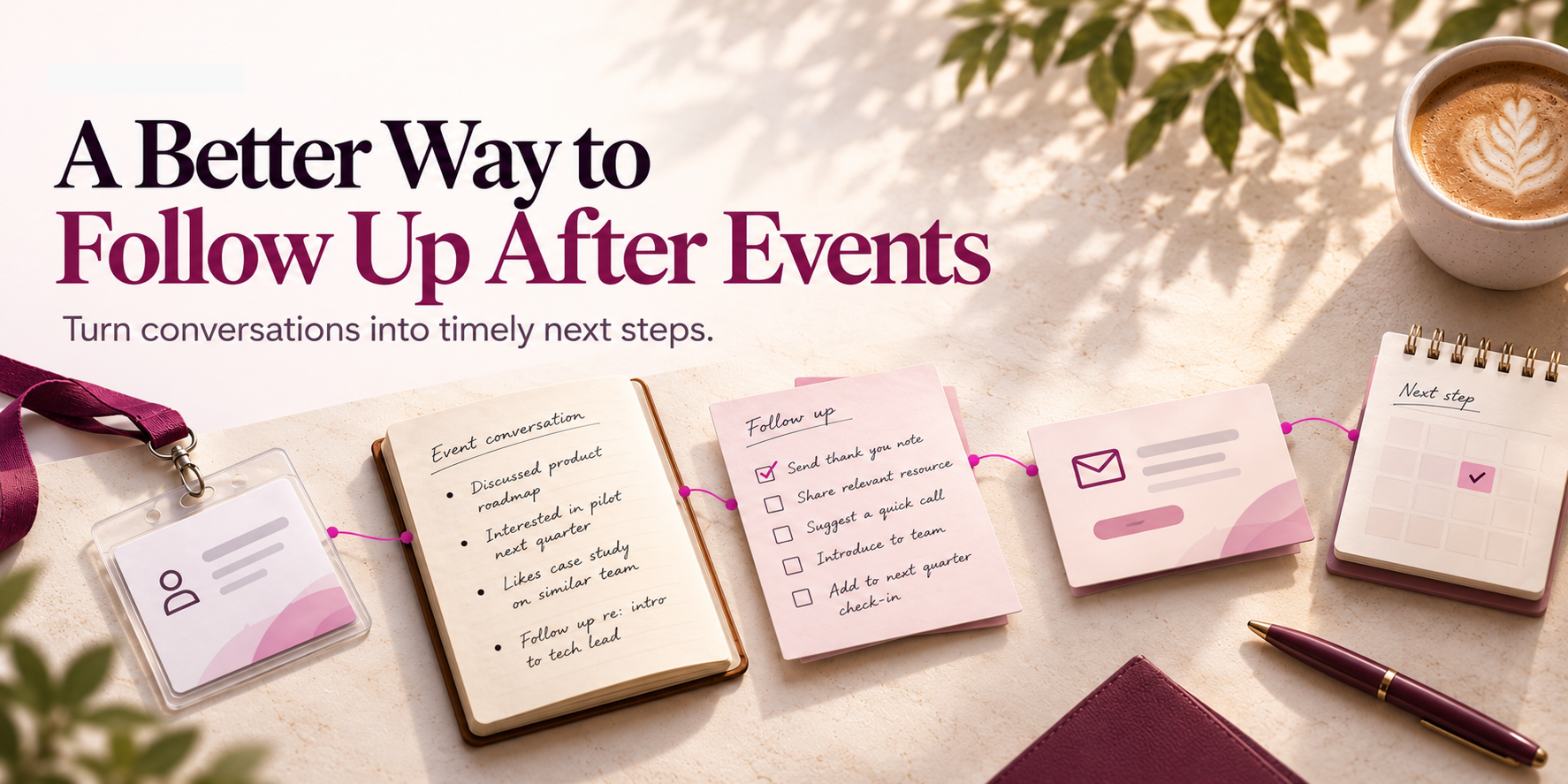
You do not need meeting minutes. A short record is usually enough:
Priya · logistics founder · met after supply-chain panel · interested in retailer partnerships · reconnect in November.
The point is to make the relationship understandable later, not to document every sentence.
If you have ten useful conversations, ten concise context notes are usually more practical than one giant event document nobody reads.
Third: make the next action specific.
“Follow up with Priya” creates another decision later. “Send Priya the retailer case study on Thursday” does not.
Weak: Follow up with Priya.
Better: Send Priya the retailer case study on Thursday and ask whether November is still the right time to reconnect.
Specific actions reduce friction because they preserve both the task and its purpose.
Fourth: write from the conversation, not from a template.
A follow-up does not need to be clever. It needs to make the existing conversation recognisable.
Example
Hi Priya, great meeting you after the supply-chain panel. Sharing the retailer case study we discussed. You mentioned November is when the partnership conversation becomes more relevant, so I’ll also circle back then.
The message works because it continues something that already happened.
Choose the channel based on the relationship.
Email makes sense when you are sharing a document, proposal or formal follow-up. LinkedIn can work well when the relationship began there or when you simply want to stay connected. Messaging apps may be appropriate if the conversation already moved there.
The channel matters less than continuity. Do not move someone across three platforms just because every “networking guide” tells you to.
Let the conversation determine the timing.
| What happened | What to do |
|---|---|
| You promised something | Complete it promptly |
| A meeting was agreed | Confirm it while the conversation is still fresh |
| There is a clear opportunity | Continue within the next few days |
| They said “come back later” | Record the timing and return then |
| Useful relationship, no urgency | Stay connected without manufacturing a CTA |
| No meaningful next step | No follow-up is required |
These are practical guidelines, not universal research-backed deadlines.
If they do not reply
Do not assume silence means the relationship was worthless. First check whether your message actually asked for a response. A resource you promised to send may not need one.
If there is a real next step, one concise follow-up is reasonable. Reference the original conversation and make the action easy to understand. If there is still no response, let the relationship rest unless circumstances change.
If you waited too long
You do not need to pretend the delay did not happen. Re-enter with context.
Example
Hi Dev, we met at the product leadership meetup in August and spoke about your move into the healthcare segment. I came across something relevant this week and realised I never followed up on our conversation. Sharing it here in case it is still useful.
A delayed but relevant message is usually stronger than a timely but generic one.
If the relationship needs a handoff
A teammate should receive the context, not just the contact. “Speak to Dev” is a weak handoff. “I met Dev at the product meetup; he is exploring healthcare partnerships and asked whether we have implementation experience there” gives the new owner a real starting point.
That preserves continuity for the person on the other side too. They should not have to repeat the entire conversation because your internal owner changed.
A practical event closeout checklist
- Complete anything you explicitly promised.
- Identify the conversations with a real next step.
- Record future timing where someone said “not now.”
- Preserve enough context for relationships that may matter later.
- Avoid unnecessary generic messages and forced meetings.
- Make sure you can still understand the important relationships three months from now.
Where Allbuddy fits
Allbuddy helps keep the person and the conversation context together. You can capture a business card or profile QR, add a text or voice update, organise the relationship by event or context, and carry forward the next action when there is one.
The useful outcome is not “more follow-up.” It is less reconstruction.
That also means Allbuddy can support different types of event relationships without forcing all of them into the same sales workflow.